


As part of Compassion: The Power to Transform conference, you can attend one of six workshops described below.
We listened to your feedback and this year we are very excited to offer two sets of workshops, one in the morning and one in the afternoon. The workshops feature all the keynote speakers, and include other leaders in their fields.
You will be asked which workshops you’d like to attend for both morning and afternoon, in order of preference. Please note that some of the morning workshops are repeated in the afternoon. Places may be limited for some workshops but we will do our best to allocate you to your preferred ones.
Morning workshops
A) How to cultivate compassion and wisdom through embodied dialogue in supervision and mentoring
Bringing mindfulness and compassion into our supervisory/mentoring relationships can support the learning and reflective process. This workshop will highlight how our mindfulness-based supervision framework can serve as a map for bringing this orientation into complex situations, in the workplace or within the supervisory/mentoring relationship.
Workshop leads: Alison Evans and Pamela Duckerin

Alison Evans and Pamela Duckerin are co-authors of the publication Mindfulness-Based Supervision and Mentoring: Using an embodied dialogue to support learning and reflection. They have been facilitating mindfulness-based supervision training together since 2019 through the Mindfulness Network.
Alison has led the development of mindfulness-based supervision for over 12 years, within the Mindfulness Network and other organisations. Supervision has been a core part of her work, encompassing supervising, training others to supervise, reflecting, researching, and writing about it.
Pamela is part of the supervision team within the Mindfulness Network and offers supervision to mindfulness practitioners worldwide. She has worked in the field of mental health for 41 years and alongside direct clinical work, clinical supervision has been a significant part of her work.
B) A radical relational view: Compassion as our fundamental orientation to working in clinical settings
The word ‘radical’ comes from the Latin word radicalis, which means ‘of or relating to the root’. And while it retains this meaning of ‘fundamental’, radical has also come to have the meaning of ‘extreme’. So, this workshop offers a chance to think together about the radical (deeper relational) philosophy underpinning a compassionate approach to healthcare (and life!). We’ll explore the far-reaching implications of taking relationality seriously in allowing compassion to permeate every area of our personal and professional lives. There will be a mixture of practice, presentation and discussion.
Workshop lead: Paul Johanson

Paul Johanson is a social worker, mindful self-compassion teacher and cognitive analytic therapist in private practice. He has worked in many areas of health and social care, including criminal justice, substance misuse, serious mental illness, psychological therapies, cancer and palliative care. He has worked as a strategic leader for the NHS in implementing national programmes in mental health, psychological therapies and patient experience. Paul is a long-term Buddhist practitioner, beginning his journey nearly 40 years ago in the Rinzai Zen Buddhist tradition, and has been a student in the Nyingma school of Tibetan Buddhism since 1991. He was the Buddhist Chaplain at the University of Sussex from 2013 to 2025.
C) What would compassionate care be like? A view from the lived perspective of being cared-for and caring
Until a few years ago, we had become used to using the term ‘care’ in mental health with reference to what we did rather than the effect it had on the cared for and the carer. Then came the time of enlightened and wise minds who introduced us to care with compassion. Before we assume the two terms to be a natural and desirable fusion, it may be useful to focus directly on what the receiving and the giving (and the two are often experienced by the same individual) actually and truthfully means in an everyday reality rather than an ideal perspective. In my opinion it’s worth it to achieve a quality of care deserved by all parties involved in this sensitive relationship.
Workshop lead: Julia Racster-Szostak
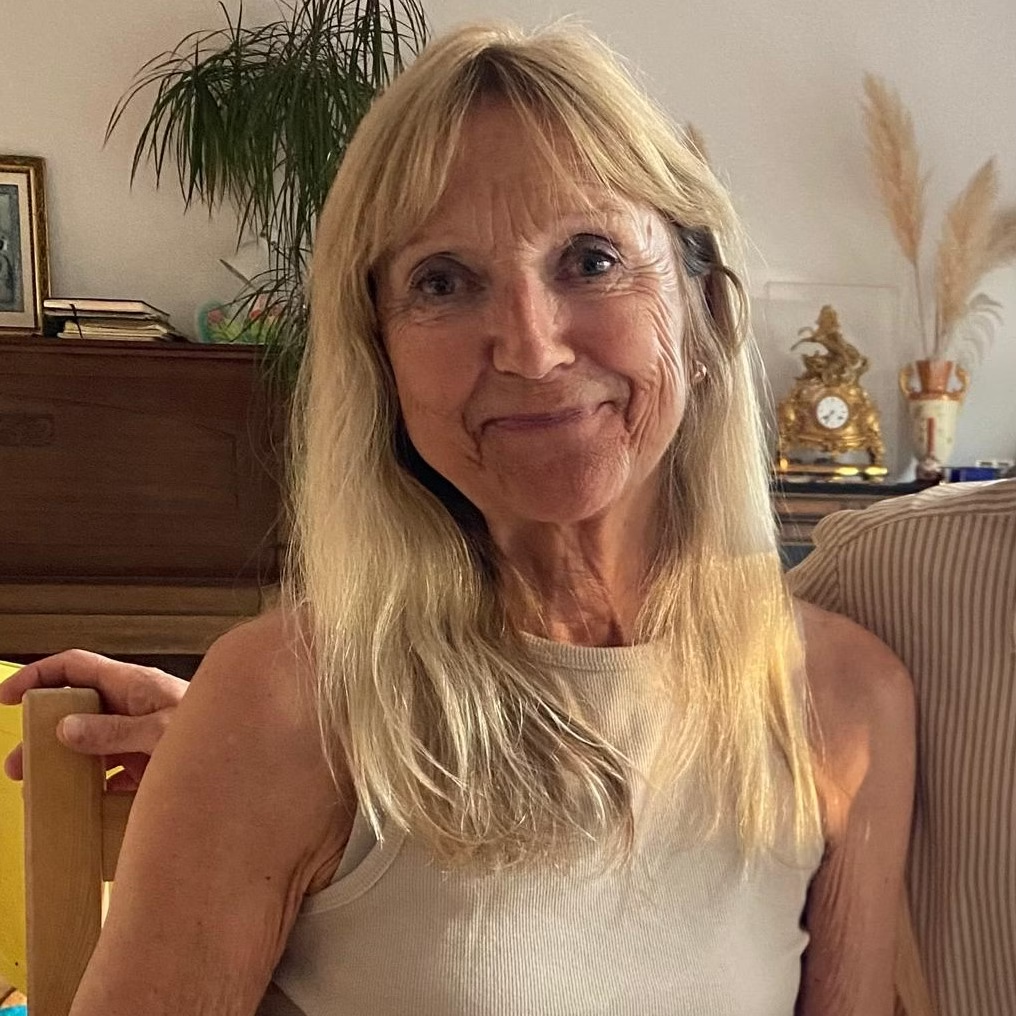
A range of careers including project manager and creator of courses for unaccompanied minor asylum seekers and then refugees from all over the world, TV presenter, song writer and manager of a personnel agency, lead to a perception of coping well with being a full time carer for two members of my family with mental health challenges and their thirteen admissions to acute psychiatric units.
But this was an illusion and that’s when I was unexpectedly introduced to mindfulness and support for carers, both with compassion and pragmatism. The twin faces of caring in one person prompted me to write about compassionate care both those being cared for and carers. I have also been the single parent of a large family for many years so reality checks are frequent in this lived perspective!
D) Changing workplace culture through compassionate leadership
Post pandemic the NHS is struggling with an epidemic of personal stress and dissatisfaction among healthcare workers, challenging our ability to recruit and retain staff and to provide the best patient care. Although the evidence for mindfulness courses to reduce stress and improve wellbeing is now overwhelming, individually targeted interventions are not sufficient. We need culture change led by leaders at all levels who are exercised not just by getting things done but by how it is done, who can work relationally and compassionately with process as well as objectives. We know that compassionate leadership is associated with improved learning and innovation, reduced staff stress, injuries and absenteeism, and even reduced patient mortality. In short, compassion for ourselves and others is essential to high quality healthcare. Sussex Mindfulness Centre has been providing a six-week compassionate leadership training to help address this. This workshop will orient participants to its rationale and experiential approach.
Workshop leads: Robert Marx and Clara Strauss

Robert is Co-Lead (Training) for the Sussex Mindfulness Centre. He is a consultant clinical psychologist and has been involved in running mindfulness groups for staff and patients since 2006. He also trains and supervises others doing mindfulness work. He is interested in relational mindfulness and in adaptations of Mindfulness-based Interventions using compassion practices.

Clara is Co-Lead (Research) for the Sussex Mindfulness Centre. She is a consultant clinical psychologist, mindfulness teacher and clinical researcher. In her research, Clara is particularly interested in developing and evaluating new forms of mindfulness-based intervention (MBI), especially for those people who may not be willing or able to access MBCT. Along with other members of her research team, Clara has been evaluating MBIs for people experiencing depression, for people distressed by hearing voices and for people experiencing obsessive-compulsive disorder (OCD). This research has also included research with NHS staff, university students and the wider population.
E) Witnessing Together – Compassion-based bereavement care
‘Grief is a forever thing and requires forever strategies’ – Alan Kelleher
Many of us will experience bereavement multiple times in our lives and yet, we don’t talk much about death or bereavement. We have lost the skill of bearing witness to each other, listening without need of feedback and talking about the end of life. Bereavement can affect us mentally, physically, emotionally and spiritually. So how can the practice of mindfulness help us to witness well, offer compassion-based bereavement care and plan for life going forward? The difference between the lived experience of profound bereavement without mindfulness and bereavement with mindfulness was striking, life changing even. The gentle yet robust practice of mindfulness helped to change how I related to complex repercussions of bereavement. Over time it offered some quietness, refuge and safe exploration, self-compassion, courage and confidence.
This workshop invites you to bring a broad awareness to the nature of bereavement, participate in small group work to hold space with compassionate presence, participate in mindful listening, and offer empathetic and kind reflection.
Workshop leads: Georgie Payne and Lynn Ley

Georgie is a mindful grief and wellbeing mentor. She has six years’ experience as an Mindfulness Based Initiatives adaptive mindfulness teacher, five years as a CRUSE Bereavement Support and two running the bereavement group at a local Sussex hospice. She is also an end-of-life doula in-training.
Lynn completed her training in Mindfulness Based interventions at Bangor University in 2010. She has been facilitating Mindfulness Based Cognitive Therapy Groups (MBCT) within Sussex Partnership Foundation Trust since 2008. Currently Lynn works with Sussex Mindfulness Centre providing supervision to trainee and trained mindfulness teachers, supporting the training team and providing competency assessments for trainees at the end of their training. Lynn has a long-standing personal meditation practice which she has found life-enhancing.
F) The nature and process of compassion: Core process in compassion focused therapy and beyond
This workshop will outline the evolutionary and biopsychosocial approach to compassion. It will take a brain state approach and explore how to create compassion brain states to offset those associated with mental health difficulties including approaches of harsh self-criticism and shame.
Workshop lead: Paul Gilbert

Paul Gilbert, FBPsS, PhD, OBE is Professor of Clinical Psychology at the University of Derby and honorary visiting Prof at the University of Queensland. Until his retirement from the NHS in 2016 he was Consultant Clinical Psychologist for over 40 years. He has researched evolutionary approaches to psychopathology with a special focus on mood, shame and self-criticism in various mental health difficulties for which Compassion Focused Therapy was developed. In 2006 he established the Compassionate Mind Foundation as an international charity with the mission statement: To promote wellbeing through the scientific understanding and application of compassion.
Afternoon workshops
G) How to cultivate compassion and wisdom through embodied dialogue in supervision and mentoring
Bringing mindfulness and compassion into our supervisory/mentoring relationships can support the learning and reflective process. This workshop will highlight how our mindfulness-based supervision framework can serve as a map for bringing this orientation into complex situations, in the workplace or within the supervisory/mentoring relationship.
Workshop leads: Alison Evans and Pamela Duckerin
Alison Evans and Pamela Duckerin are co-authors of the publication Mindfulness-Based Supervision and Mentoring: Using an embodied dialogue to support learning and reflection. They have been facilitating mindfulness-based supervision training together since 2019 through the Mindfulness Network.
Alison has led the development of mindfulness-based supervision for over 12 years, within the Mindfulness Network and other organisations. Supervision has been a core part of her work, encompassing supervising, training others to supervise, reflecting, researching, and writing about it.
Pamela is part of the supervision team within the Mindfulness Network and offers supervision to mindfulness practitioners worldwide. She has worked in the field of mental health for 41 years and alongside direct clinical work, clinical supervision has been a significant part of her work.
H) A radical relational view: Compassion as our fundamental orientation to working in clinical settings
The word ‘radical’ comes from the Latin word radicalis, which means ‘of or relating to the root’. And while it retains this meaning of ‘fundamental’, radical has also come to have the meaning of ‘extreme’. So, this workshop offers a chance to think together about the radical (deeper relational) philosophy underpinning a compassionate approach to healthcare (and life!). We’ll explore the far-reaching implications of taking relationality seriously in allowing compassion to permeate every area of our personal and professional lives. There will be a mixture of practice, presentation and discussion.
Workshop lead: Paul Johanson
Paul Johanson is a social worker, mindful self-compassion teacher and cognitive analytic therapist in private practice. He has worked in many areas of health and social care, including criminal justice, substance misuse, serious mental illness, psychological therapies, cancer and palliative care. He has worked as a strategic leader for the NHS in implementing national programmes in mental health, psychological therapies and patient experience. Paul is a long-term Buddhist practitioner, beginning his journey nearly 40 years ago in the Rinzai Zen Buddhist tradition, and has been a student in the Nyingma school of Tibetan Buddhism since 1991. He was the Buddhist Chaplain at the University of Sussex from 2013 to 2025.
I) Mindfulness for all: Cultivating true inclusion in mindfulness spaces
The mindfulness space is often unintentionally exclusive. Meaningful change begins with open and honest conversation rather than toolkits or checklists.
The purpose of the workshop is to create a safe space where people can listen to real experiences of exclusion, share their own stories, and explore how those moments made individuals feel. It doesn’t set out to provide definitive solutions for inclusivity. Through these shared reflections, participants can begin to imagine what change might look like and how each person can contribute to creating more welcoming spaces. Guided by the conference theme of compassion, we see people simply as people, beyond labels such as neurodiversity, race, or sexual orientation. True inclusivity comes from genuine human connection rather than performative diversity.
The workshop will include panel introductions, where speakers share personal experiences and reflections. Participants will be encouraged to engage openly, ask questions, and reflect together, leaving with greater confidence to have compassionate conversations and help others feel safe, seen, and welcome.
Workshop lead: Michelle Albert

I’ve always had a natural affinity for all things wellness and mindfulness, but what truly qualifies me as an advocate and practitioner is my lived experience. Mindfulness has been my anchor through stress, anxiety, burnout, and grief – helping me build resilience and navigate life with more clarity and compassion. I’m currently facilitating a mindfulness-based resilience programme in the education sector for young professionals facing the pressures of a fast-paced, ever-changing world. I’m nearing completion of my mindfulness teacher training with Sussex Mindfulness Centre. I joined the Sussex Mindfulness Centre, as an advocate as a way to find my voice and share mindfulness openly with my personal and wider communities. However, as I became more involved in the mindfulness space, I noticed that it often felt unintentionally exclusive — first as a participant and later as a practitioner. This is what led me to offer this workshop.
J) One-to-one Mindfulness: A compassionate connection for living with awareness
Mindfulness and compassion-based learning often happens in groups, and for good reason – following a tried-and-tested curriculum with others brings insight into the commonalities of human experience and offers mutual support as people develop a meditation practice. But has the emphasis on group training obscured the potential for a personalised approach? In one-to-one mindfulness sessions, meditation and inquiry are guided according to the unique needs of an individual moment-by-moment, creating a flexible, responsive, and intimately relational approach to learning. In this way, one-to-one sessions enable a compassionate connection that helps transformation happen. In this session, we will look at what one-to-one sessions can and can’t offer, what frameworks they can draw on, who can benefit, and how this emergent approach might evolve as the mindfulness field changes and matures.
Workshop lead: Ed Halliwell

Ed Halliwell is an experienced mindfulness teacher and supervisor. He discovered mindfulness in 2001, during a period of depression and anxiety, and found it transformative. After several years developing his own practice, including a year-long stay at a meditation retreat centre, he trained to teach at the Centre for Mindfulness Research and Practice (CMRP) at Bangor University, and has been teaching mindfulness full-time since 2010. He leads courses and retreats in-person in Sussex and globally online, working with a wide range of individuals and groups. Ed has taught mindfulness in organisations such as Imperial College Business School, Tate, Ardingly College, Accenture, UNICEF UK, and The Guardian.
K) Conscientious compassion: turning towards our world as practice
In the practice of mindfulness, we learn to turn towards ourselves with compassion, to meet our pain with tenderness and care. Yet the need for compassion does not end there. How might we widen it to extend towards each other, the living world of which we are a part and to a planet in distress? To love this troubled, hurting,world asks us to have courage. It asks us to stay open and connected, even when that feels difficult. In this workshop we will draw on the work of the late environmental activist and Buddhist scholar Joanna Macy to explore how we might cultivate a robust compassion rooted in love, joy and gratitude. A compassion that is tender and strong, that connects, sustains and renews. One that can turn towards the challenges of our times, without turning away.
Workshop lead: Rosalie Dores

Rosie Dores is a mindfulness teacher, trainer and supervisor. She is an Insight Dialogue retreat teacher and relational mindfulness teacher. She has practiced meditation and yoga since 1992. The combination of both has evolved into a somatically informed approach to teaching. Rosie is dedicated to offering teachings that engage at the interface between ancient wisdom and the challenges of our modern world. She recognises that relational meditation addresses the urgent need for a meditative practice that incorporates the social and interpersonal domains of human experience as intrinsic to ‘waking-up’ for all of us. She co-teaches courses and workshops dedicated to raising awareness about climate and social justice. Rosalie is a Work That Reconnects facilitator.
L) The nature and process of compassion: Core process in compassion focused therapy and beyond
This workshop will outline the evolutionary and biopsychosocial approach to compassion. It will take a brain state approach and explore how to create compassion brain states to offset those associated with mental health difficulties including approaches of harsh self-criticism and shame.
Workshop lead: Paul Gilbert
Paul Gilbert, FBPsS, PhD, OBE is Professor of Clinical Psychology at the University of Derby and honorary visiting Prof at the University of Queensland. Until his retirement from the NHS in 2016 he was Consultant Clinical Psychologist for over 40 years. He has researched evolutionary approaches to psychopathology with a special focus on mood, shame and self-criticism in various mental health difficulties for which Compassion Focused Therapy was developed. In 2006 he established the Compassionate Mind Foundation as an international charity with the mission statement: To promote wellbeing through the scientific understanding and application of compassion.