
Sussex Mindfulness Centre logo
NHS Sussex Partnership - NHS Foundation Trust logo

Tag: mindfulness

  • Free mindfulness taster

    Free mindfulness taster

    20 January at 18:00 to 19:00

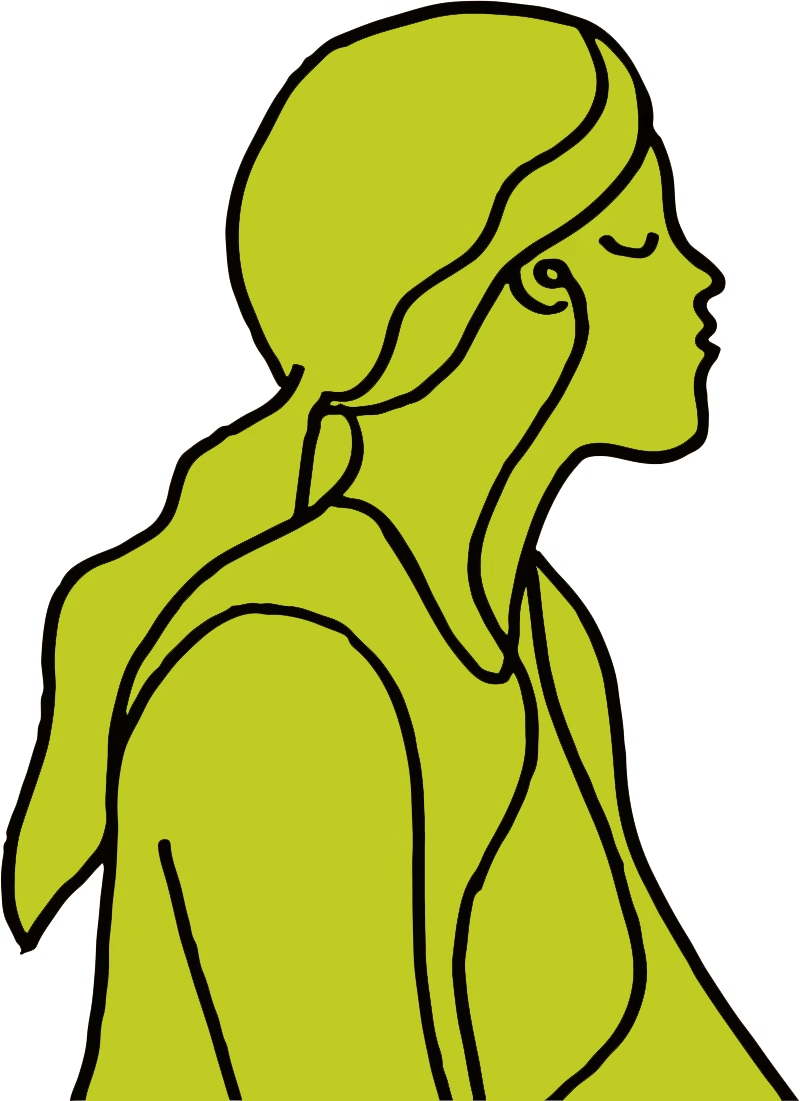
    line drawing of women listening to meditation practice

    Are you considering whether mindfulness is for you? Join our free online taster session. This one-hour taster session will introduce you to the benefits of mindfulness. Benefits include improved wellbeing and ability to manage stress.

    Is your mind over active? Do you find you can’t turn off? Are you running on empty, unable to appreciate things that previously made you happy? Are relationships more fraught than they were?

    Perhaps it’s time to try mindfulness.

    Brief overview

    In this informative one-hour online session, you will:

    • Learn what mindfulness is
    • Meet one of our teachers
    • Try short-guided meditations
    • Discover the benefits of mindfulness
    • Find out about our short introductory mindfulness and beginner courses
    • Ask any questions about mindfulness and what your next step might be

    This session is for you if:

    • You are completely new to mindfulness and meditation and want to try it out.
    • Are returning to mindfulness and want a refresh / reminder about what is involved.
    • Are wondering how mindfulness might help your team and colleagues at work.
    • Are familiar with mindfulness but keen to know what the Sussex Mindfulness Centre can offer.

    Where?

    Online on Zoom

    For all mindfulness work, the connection between people in the group is central to the discovery and learning process. Please ensure the camera on your device is turned on during the session and try your best to join from a quiet, private space. Thank you.

    SMC

  • Emily Kenneally: My journey with mindfulness

    Emily Kenneally: My journey with mindfulness

    How mindfulness helps me stay grounded and self-compassionate while living with ADHD 

    “I didn’t think that I was the sort of person that could sit down and meditate or that I had the focus for it. It’s wonderful to discover that about yourself.”

    Emily Kenneally, a writer for a mental health charity supporting educators and a creative workshop facilitator, shares her journey with mindfulness and how it helps her stay grounded and self-compassionate, while living with ADHD.

    This blog post is based on an interview with Tamsin Bishton using Emily’s words. It’s part of a blog series “My journey with mindfulness” edited by Tamsin.

    How I came to mindfulness 

    I was diagnosed with Generalised Anxiety Disorder in my twenties and discovered origami as a calming hobby. I began running origami workshops for people of all ages and I got really curious about why engaging with this activity was helping us. After lots of conversations, I realised that it was a kind of mindfulness. Making origami asks you to engage your senses and be in the present moment. It is also an activity that encourages connection and thoughtful conversations. 

    I read about mindfulness and the different kinds of practices that you can do, and began listening to guided meditations. But it was challenging practicing alone, so I joined an eight-week Mindfulness Based Cognitive Therapy course at the Sussex Mindfulness Centre. 

    The group was supportive and it felt accessible and practical. I learned techniques I could use daily, both short and long, which helped me notice emotions at stressful moments and recognise unhelpful patterns of behaviour. Over time, I began to feel safer in my body. I could pay attention to my breathing, once a source of anxiety, which became something I could return to for steadiness. 

    I discovered that mindfulness isn’t just solitary; the guidance of the teacher and the shared experiences within the group were essential in helping me experience the benefits. 

    Learning mindfulness enhanced my resilience in daily life, inspiring me to share its benefits with others. I decided to train to teach Adapted Mindfulness-based Interventions, to support individuals who may find longer practices or the traditional eight-week programme challenging.

    Personal benefits of mindfulness

    Mindfulness helps ground me, more than I ever anticipated. I feel more comfortable in my skin. I didn’t think that I was the sort of person that could sit down and meditate or that I had the focus for it. But I found, little by little, I have been able to build that up. It’s wonderful discovering that about yourself.

    I was diagnosed with ADHD not long ago. There’s a misconception that people with ADHD can’t concentrate. Often, for me, it’s quite the opposite! I can hyperfocus on things that matter to me, work for example, and I really struggle to pull myself away. 

    Mindfulness helps interrupt my periods of hyperfocus and puts me back in touch with my body. It helps me ask: what am I feeling? What is my body trying to tell me? How can I support myself? When it comes to meditation, I can do it, it’s just that I do it in smaller steps and build it into my life in different ways. 

    ADHD often coexists with other conditions. A hypermobility disorder affects all my joints, causing chronic, daily pain. Mindfulness helps me live alongside the pain by helping me be compassionate and accepting, so my emotional suffering is less. It also helps me to listen to my body, rest with less guilt and be active when I can, which impacts on the severity of the pain. 

    Mindfulness isn’t a panacea, but it does make my difficulties feel more manageable. 

    Work related benefits and secondary benefits

    Since completing the training, I’ve been able to continue to develop my creative workshops and incorporate mindfulness approaches. It has also helped inform the mental wellbeing resources I write for educators. I’m now developing my mindfulness teaching to support people with ADHD and those in workplaces, who may benefit from engaging in shorter practices. You can learn about my ‘Mindfulness with ADHD’ and workplace sessions here. Or you can join a creative origami workshop here.

    Encouragement for anyone considering trying mindfulness

    A few mindful moments can shape your day, your choices and how you take care of yourself. It’s not mystical; it’s rooted in everyday experiences and may help you to navigate life’s challenges.

    Mindfulness is a word that’s thrown around a lot now. To truly gain the benefits and understanding, I encourage you to learn through a fully trained practitioner and within a supportive group, where insights are deepened and sustained.

    Join a free taster

    If you’re interested in learning mindfulness for yourself, then please do come along to one of Sussex Mindfulness Centre’s taster sessions. They’re free. You get to experience a practice as well as hear a little bit more about what’s involved in the various mindfulness courses that we offer. Most of our courses are online and can be booked by individuals.

    And if you would like to share the magic you can join a free online teacher training information session. Or if you’d like to find out more about becoming an advocate check out our Advocates page.

  • Innovations award for our work with refugees, one year on

    Innovations award for our work with refugees, one year on

    A year after we won an award for our work with refugees and asylum seekers, we’ve come to the end of two more ten-week mindfulness courses. This time the venue was a very special ‘secret’ garden. This blog post, by Julia Powell one of the facilitators, is based on a short update for the Innovations in Mindfulness Awards.

    What winning the award meant to us

    When we won an Innovations in Mindfulness award for our work with refugees in October 2024, it meant a huge amount to us: it represented recognition of the original Mindfulness Across Borders curriculum developed by Ariana Faris and Sheila Webb; it acknowledged our efforts to revive the programme, innovate further and reach new groups in Brighton; and it provided an injection of cash, which when supplemented by the Sussex Mindfulness Centre’s own funds, meant we could run two more ten-week courses for migrants, refugees and asylum seekers this year.

    The first of our wellbeing courses this year started in May, and the second started in early July and finished last week, 30 September 2025. The participants, and facilitators, were a little sad at our final gathering, but we hope it’s not the end.

    The Secret Garden and its healing properties

    Given the positive response to running the last course in 2023 in a secluded wellbeing garden just out of Brighton, we ran these two courses outdoors again. The Secret Garden, a little-known sculpture garden, run by community volunteers in urban Kemptown was the venue for these last two courses. We are grateful to the Antony Dale Trust who hosted us.

    Holding the courses in a special garden built on the eco-therapy aspect of the course that Lana Jackson introduced when we ran our second course. With the blessing and support of Ariana Faris (one of the originators of the curriculum), Lana has since added to the curriculum. This will help other mindfulness teachers take the course outside and into nature.

    Photo of the garden with seats laid out ready for participants

    The garden made a huge contribution, creating a little oasis of tranquillity in nature for participants to engage in mindfulness practices and other exercises. This felt particularly important given the vulnerability of the participants who experience high levels of emotional turmoil caused by their current circumstances and the situations they have left behind.

    We opened the course to women and men

    Although the trauma-informed, culturally sensitive curriculum was originally designed for women, we decided to open the last course to both men and women, as we were hearing of the difficulties that men here on their own were facing.

    Robert demonstrating how we add optional suffering to inevitable pain

    Robert Marx, Co-Lead of the Sussex Mindfulness Centre, and the son of a refugee himself co-taught on this course. Originally, it was Robert Marx who identified refugees and asylum seekers as a possible group for Sussex Mindfulness Centre’s work with underrepresented communities. This proved to be a well-appreciated intervention for the men that attended. And we felt for some women that being in be in a mixed environment that was safe and respectful, may have been helpful, and even healing in itself. We are delighted to be offering an intervention that includes men, who are normally massively under-represented in mental health services (particularly important given the much higher suicide rates in men).

    We were fortunate and privileged to have Ariana Faris, as the originator of the curriculum, to provide supervision. This supported both the effectiveness and safety of the group, and enabled us to think through and plan together throughout the delivery of both courses.

    Building connections and recruiting participants

    To attract participants to attend the mindfulness courses we did extensive outreach into the refugee community building on links we had made previously. The Network of International Women for Brighton & Hove helped us to recruit participants for the first women-only group. We reached out to other refugee groups by attending meetings, celebrations and cultural events to talk about the course, meet organisers, refugee leaders, and potential participants. We also attended coordination meetings where services for refugees were discussed to inform them of our plans, and ensure our courses were included in communications to the wider network of service providers. As a result, we recruited around 25 participants for both groups and had around 10 participants attending each session. The second course was oversubscribed, and we had to turn people away.

    Proudest moments

    The proudest moments have come when participants have said something that indicates what the course offered them. Here are four quotes from participants:

    “I would never go out on my own. Since I’ve been coming here, I’ve gone to the local park, I’ve walked bare foot, even lay down on the grass and looked up at the clouds. I would never have done that before.”

    woman refugee

    “…I like speed. I like to arrive places quickly and accomplish things with momentum. But today, as I walked, I really watched where I was placing my feet. I noticed something small but striking; I was avoiding stepping on flowers. I wondered why. And the answer came quietly—a simple realisation of their existence. I appreciated them. Out of all the grass in the garden, these were the plants that had chosen to bloom. To offer something beautiful. And somehow, that helped me appreciate nature—and, as a result, appreciate life. It may sound simple, but it was deeply meaningful to me, especially in a time when I’ve found myself giving up on life….”

    woman asylum seeker (excerpt from message sent after class)

    “After listening to the other people in the group talk, I realise I am not alone.”

    male asylum seeker

    “After waking up, my whole heart is filled with worry and anxiety…I am always, always worried for no logical reason. In your training sessions, I feel calm. And I see that it is a safe environment.”

    male asylum seeker (excerpt from message sent after class):

    Next steps …

    Participants would like some way of continuing to meet to support them in their practice. The expanded team involved in running and supervising these courses (Ariana Faris, Lana Jackson, Robert Marx, Lizzy West, Lara Alvarez Torres and myself, Julia Powell) are planning to get together in-person to brainstorm how we can raise funds to run the courses again. Irrespective of funding we will consider how to offer monthly mindfulness sessions in a free venue so that participants have a way to stay connected to the community they have created and the practices they have embarked on.

    We’ll keep you posted on further developments here.

  • Opening the Heart: online compassion retreat  

    Opening the Heart: online compassion retreat  

    Compassion for self and others

    6 February at 14:00 to 8 February at 13:00

    Image of a heart in hands against green background

    A long-weekend retreat from your own home. You’ll be supported to deepen your mindfulness and compassion practice and experience stillness and silence. A chance to open your heart and listen to your deep intentions.

    Brief overview

    This retreat will offer mindfulness and compassion practices designed to deepen self-care and our intention to benefit others. Althought the retreat is entirely secular, the over-arching framework for it this year will be the Tibetan Lo Jong or Mind Training guidance and practices. These practices are widely used in Tibetan Buddhism and are an inspiring guide for cultivating compassion.

    For participants who attended last year’s retreat of the same name, this retreat is different. As Mindful Self-Compassion teachers and practitioners in the Tibetan Buddhist tradition, Robert and Paul have used the framework of the Lo Jong Mind training slogans to shape the retreat. This will help foster qualities of the heart, such as tenderness, courage and kindness, that are essential for living life to its fullest and deepest extent. This retreat will offer the same focus on opening the heart, but with slightly different content so that people who came last year would experience a different approach.

    There will be a mix of teaching, guided and unguided practice, and unstructured silent time. Most of the retreat will be held in silence, though there is the possibility to talk to either of the teachers individually at any point.

    The programme itself will run through Friday afternoon until Sunday morning. 

    Where is it?  

    Online. You can attend from your own home whether or not you live with others. You will be given guidance on how to prepare for the retreat.

    Who is the retreat for? 

    The retreat is designed for people with some experience of mindfulness and/or compassion practice who want to deepen their practice in a supportive, safe environment. As a minimum, participants should have a regular practice of their own and should have done an eight-week mindfulness-based or compassion-based course and have attended at least a one-day, silent retreat.

    It is also a great opportunity for mindfulness-based and compassion-based teachers to approach this area in a new way. The retreat will count towards the annual retreat requirement for teachers and supervisors on the BAMBA Register.

    Retreat leaders

    Robert Marx

    Portrait photo of Robert Marx

    Robert Marx is co-lead for the Sussex Mindfulness Centre and leads the Mindfulness Based Cognitive Therapy (MBCT) in Talking Therapies in NHS services training centres collaboration. He is a clinical psychologist and psychotherapist and has been teaching mindfulness to patients and staff in the NHS for 18 years. He teaches MBCT and Mindful Self-Compassion.  He has been practising Buddhist meditation for over 30 years, initially in the Theravadan tradition and then in the Tibetan tradition.  He is passionate about building compassionate cultures in organisations and about integrating relational and mindful approaches to work. 

    Paul Johanson

    Portrait photo of Paul Johanson

    Paul Johanson is a social worker, a teacher of Mindful Self-Compassion and a cognitive analytic therapist working in private practice. He has worked in various areas of health and social care, including criminal justice, substance misuse, serious mental illness, psychological therapies, cancer, and palliative care. He has also worked as a strategic leader for the NHS, implementing national programmes in mental health, psychological therapies, and patient experience. A long-term Buddhist practitioner, Paul began his journey over 35 years ago in the Rinzai Zen Buddhist tradition and has been a student in the Nyingma school of Tibetan Buddhism since 1991. From 2013 to 2025, he was the Buddhist Chaplain at the University of Sussex.

    How much does it cost? 

    The cost is £250.

    How do I apply?

    Please download and fill this application form and when completed return it to spft.smc@nhs.net.

    The purpose of this is to understand what we need to know to support you properly. If we have any concerns about anything in your form, we will contact you.

    1. On offering you a place we will issue an invoice for the full amount.
    2. Your place is confirmed once we receive full payment. Please note the terms below for refunds.
    3. Any bursary reductions will be offered by 1 Dec 2025, and earlier if possible.

    Are bursaries and payment instalments available? 

    Once we break even, we will offer reductions to those who request them in their application form. These are likely to be very modest and we won’t know what we can offer until fairly near the start of the retreat. We can offer payment in two instalments.

    Please contact spft.smc@nhs.net to request a bursary or to pay in instalments. Any bursary reductions will be offered by 1 Dec 2025, and earlier if possible.

    How to book?

    To secure your place you can book here

    SMC

  • Georgie Payne: My journey with mindfulness

    Georgie Payne: My journey with mindfulness

    How mindfulness has helped me to live with my own grief and support others with theirs

    “I work as a grief and wellbeing mentor and the skills of mindfulness have become an integral part of this work.”

    Georgie supports private clients, is a bereavement group lead at a local hospice and an end-of-life doula in-training.. She also spent four and a half years as a bereavement support at CRUSE Bereavement Support. Here she describes how mindfulness helps her to learn to live with her own grief.

    This blog post is based on an interview with Tamsin Bishton using Georgie’s words. It’s part of a blog series “My journey with mindfulness” edited by Tamsin.

    How I came to mindfulness

    I experienced profound bereavement in 2000 and it was life changing. At that time, everyday language around therapy, accessing counselling support or relying on wellbeing at work was not as it is now. It took a long time to learn to live with my grief and I relied heavily on patient and strong friend and family relationships.

    For me, everything had changed. Finding the focus and energy for my demanding career was hard, I went travelling and I partied, finding escapism in music and dancing. I loved the tribalism of groups of friends, the groundedness and physicality of dancing. Yet none of this stopped the circular thoughts and questioning nature of my grieving brain.

    I’d seen a random article on mindfulness meditation, and even though I was curious, I forgot about it with the busyness of life with a young family. A year or two later the article reappeared and I thought I’d give it a whirl. I found it to be transformational. Bit by very slow bit, the circular, questioning thought patterns started to lessen. I connected fully with this gentle-but-robust training of the mind that offered easier quietness, safe exploration, gentleness and compassion to me and, by default, to those around me.

    It was an immediate decision to start the eight-week Mindfulness Based Cognitive Therapy course. I followed this with the mindfulness teacher training for Brief & Adapted Interventions at the Sussex Mindfulness Centre. Many other trainings, events and courses in mindfulness, mindful-self compassion and mental health followed after that. Now, I work as a grief and wellbeing mentor and the skills of mindfulness have become an integral part of this work.

    Personal benefits of mindfulness

    Mindfulness has helped me in profound ways with the overwhelm of bereavement and the prospect of life going forward:

    • It helped me factor in quiet time into my day, even for five or ten minutes.
    • I felt less caught up in my thoughts and more connected to my body.
    • I learnt new skills and practices – from breath practices to body scans, to mindfulness of sights and sounds and everything in-between.
    • It gave me confidence to investigate and to know how I am in any given moment.
    • I found a way to relate differently to life’s events and the world around me.
    • It helped to reaffirm my personal values and boundaries.

    The contemplative time of mindfulness offers space to connect inwardly with my loved ones.
    Ultimately, I give huge value to the qualities of self-reliance of mindfulness. To be able to confidently check in on myself, to access skills at any time and in any place, and the ability to offer myself care during difficult times is invaluable.

    The wider benefits of mindfulness

    The experience of bereavement is uniquely different for everyone, the intensity of emotions, how complicated they are, and how long they will last are questions no one can answer. Grief never goes away, but we can learn to live with it in whatever shapes or forms it may arise in our daily lives.

    With the skills of mindfulness I slowly started to feel comforted, settled and strong again, happier in the knowledge that I would cope better with life’s ups and downs going forward.

    I have enormous respect and gratitude to all the different teachers and friends that I have made in this world of mindful meditation. I am delighted to be an advocate for such a worthwhile organisation as the Sussex Mindfulness Centre.

    You can find out more about Georgie’s work on her website here.

    Join a free taster

    If you’re interested in learning mindfulness for yourself, then please do come along to one of our taster sessions. They’re free. You get to experience a practice as well as hear a little bit more about what’s involved in the various mindfulness courses that we offer. Most of our courses are online and can be booked by individuals.

    And if you would like to share the magic you can join a free online teacher training information session.

    And if you’d like to find out more about becoming an advocate check out our Advocates page.

  • Compassion: The Power to Transform, conference 15 May 2026

    Compassion: The Power to Transform, conference 15 May 2026

    We are excited to announce the date and theme of our next annual conference.

    The Sussex Mindfulness Centre’s twelth annual conference will explore compassion and it’s ability to create change from the personal to the global.

    The conference will take place on 15 May 2026, at the Friend’s Meeting House in Brighton.

    The theme of the conference is: “How can compassion help to transform: our own difficult experiences; tricky relationships (with family, friends and colleagues); challenging workplaces (especially in the NHS/NHS teams) and crises in wider society and globally (such as conflict, political/social divides, climate change).”

    We have some special speakers and workshop facilitators lined up to help us explore this topic.

    Speakers have been announced and tickets will go on sale shortly. Make sure you don’t miss out. Sign up to our newsletter to get further news.