


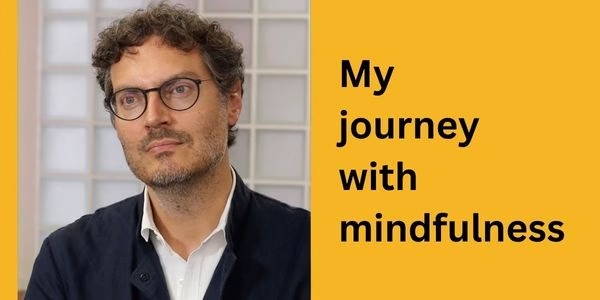
Jon Wheatley, Consultant Psychologist and Clinical Lead at Homerton Healthcare NHS Foundation Trust, describes how mindfulness has shaped his career, transformed his service, and changed the way he relates to his own experience.
“It makes you a better therapist. I’m pretty sure it makes you a better person as well.”
This blog post came out of an interview with Jon Wheatley, by film maker Sarah West for a short film. Tamsin Bishton the editor of the blog series “My journey with mindfulness”, created the post from the interview transcript.
How I came to mindfulness
Mindfulness has been a thread running through my personal and professional life since I first trained as a clinical psychologist 24 years ago. I attended my first mindfulness retreat just a year after completing my clinical psychology training, and it was a wonderful experience. I learned so much about the phenomenology of my own mind, and I saw so much overlap between what I’d learned in my clinical psychology training and on the mindfulness retreat.
It used to be that you had to go into a shop that sold incense and tie dye t-shirts to find a book about mindfulness. I was intrigued, but there was also, in the back of my mind, a sneaking suspicion that it was some kind of cult! As the mindfulness research developed, I was incredibly reassured that people like John Teasdale, Mark Williams and Melanie Fennell – very grounded, very rigorous in their research – got involved in developing the programme.
It’s wonderful that we’re able to offer this now as part of the NHS Talking Therapies programme. It’s fantastic that mindfulness is now part of the NICE guidelines, and it’s a real gift for staff to train in this approach.
Personal benefits of mindfulness
It’s about becoming more aware of your own experience – tuning into thoughts, feelings and sensations. The more aware we are of our own experience, the better our decisions. We can choose how to respond to life’s difficulties rather than reacting out of habit.
When I taught my first Mindfulness Based Cognitive Therapy (MBCT) group here in the service, I found it an incredibly moving experience. I felt I was learning from the participants as much as I was teaching.
Depression can be a very lonely place. There’s a particular moment that stayed with me, during a standard exercise about the territory of depression where I read out a list of negative self-statements people have when they’re depressed.
I looked up and there were tears. One of the participants said, ‘hearing these words, I thought that was me, but now I can see it was a story.’ People got up, they hugged each other. It was profoundly moving.
People, maybe for the first time, got the idea that you are not your thoughts. Something I’ve been trying to teach in individual therapy over the years, but this was the first time it really landed.
It makes you a better therapist. I’m pretty sure it makes you a better person as well – if you learn to be more present and curious, you respond rather than react. I’m confident it makes me a better manager and colleague, with greater attention to my own experience.
Work related benefits
Now that we’ve got a group of therapists trained to deliver MBCT in our NHS Talking Therapies service here in City and Hackney, we can offer the full range of evidence-based talking therapies for depression. It can be used as a standalone treatment. It can be used at the end of individual therapy as a relapse prevention programme. So it’s a great option as part of the stepped care model.
As a service manager and clinical lead, the mindfulness based teacher training programme has made me a better leader and advocate for my staff. It enables me to remain more calm and balanced amid the pressures of the service. I feel more able to protect my staff and take a stand – braver, more willing to push back when too much is being asked of my service and staff.
I was really keen to train up as many of my staff as possible in MBCT, partly because the approach really helps us understand the mechanisms that cause and maintain psychological distress, but also because it’s incredible for staff wellbeing. I wanted it to become part of the service culture. We now have mindfulness champions who act as a resource for other staff interested in mindfulness, either for their patients or for themselves. There’s an underlying thread of mindful attention, presence, curiosity that has enriched everybody in the service, not just those who’ve completed the training.
One of the key learnings from the Francis Report in 2013 is that there’s a danger in the NHS of meeting the targets but missing the point. Mindfulness teaches you to never remove yourself from that patient experience, so always staying present in the service of your patients. And if you do that, you make better decisions, personally and professionally, about what’s best for your service users, your colleagues, and yourself.
__________________________________________________
If you are struggling with depression, suicidal thoughts or acute anxiety visit your doctor. There are a wide range of treatments available including, if relevant, Mindfulness Based Cognitive Therapy.
If you work in NHS Talking Therapies you may like to explore Mindfulness Based Cognitive Therapy.
If you are a therapist and may like to consider mindfulness either the MBCT teacher training or Adapted & Brief Interventions.
If you want to flourish and thrive, rather than simply survive, perhaps give mindfulness a go. We have free online lunchtime and evening taster sessions every month, and a range of mindfulness courses to choose from.
Photo credit: Sarah West